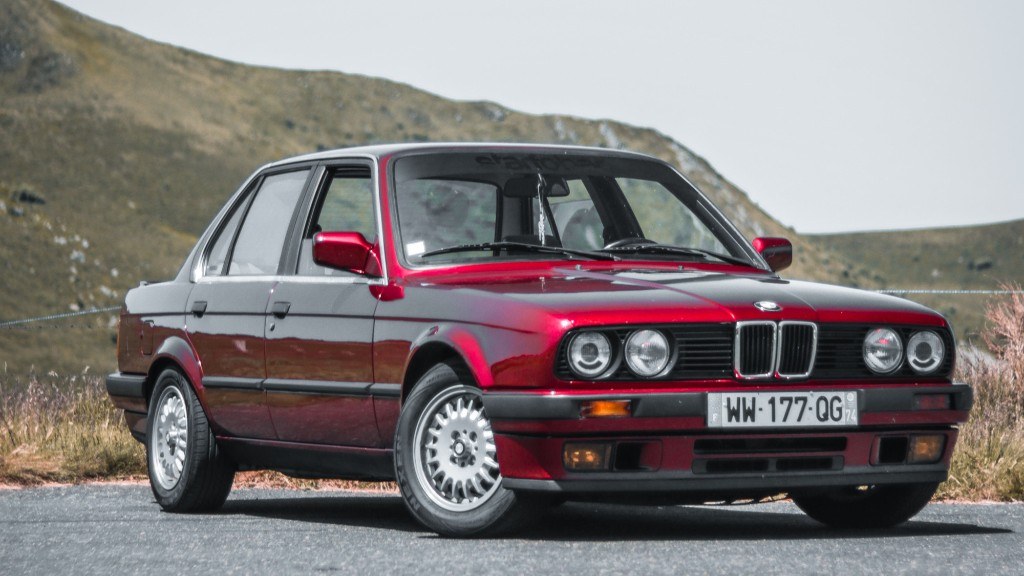
In brief
The E30 is the 3 Series with which BMW finally established itself in the compact class: over 2.3 million cars from 1982 to 1994, as a two- and four-door saloon, a Convertible and, for the first time at BMW, a Touring. Technically it is robust and well supplied, and parts availability is excellent. The problem is the past of many cars: for two decades the E30 was cheap entry-level and drift material. Hacked-about, hard-driven examples are more common than honest ones, and paint that shines says nothing about welded jacking points or an overdue timing belt.
The short recommendation: the 325i with the M20 six-cylinder is the E30 in essence: strong, vocal, and the most in demand on the market. If you want to drive open, the Convertible is the most value-stable body concept; the rare Touring has a loyal following. Four-cylinders are the cheap, honest way in. The M3 with the S14 four-valve engine is a completely separate price league (six figures) and is not covered here. Substance matters more than the engine: an unmolested 318i with history is the better buy than a cobbled-together 325i.
Variants and production years
- 316 / 316i / 318i (1982–1994): four-cylinders with 75–113 hp. Early cars have the M10 cast-iron engine (very robust); from 1987 the M40, with the known camshaft wear. The cheap way into the series.
- 318is (1989–1991): M42 four-valve engine, 136 hp, a timing chain instead of a belt. The most agile four-cylinder, and a quieter pick.
- 320i / 325i (1982–1991): M20 six-cylinder, 125–171 hp. The 325i (from 1985) is the most sought-after production model; also built as the all-wheel-drive 325iX.
- Convertible (1986–1993): a proper four-seater convertible without a roll bar, mostly as 320i and 325i. Built until 1993 alongside the E36 successor.
- Touring (1988–1994): the first BMW estate, developed from a factory prototype. Rarer than the saloon, with its own collector following.
- VFL/NFL: the autumn 1987 facelift brought plastic bumpers instead of the chrome bumpers known as the Bundes-Stossstange, larger rear lights and revised sills. Early chrome cars (VFL, pre-facelift) are seen as more classic, late NFL cars (post-facelift) as more usable every day. Both have their market.
The M3 (1986–1991), with the high-revving S14 four-cylinder and a widened body, is its own price league as the touring-car homologation model and needs a buying guide of its own.
Body: rust in known places
The E30 does not rust across whole panels, but at clearly known points, which are often disguised:
- Rear wheel arches: the classic E30 spot. The folded edges rot from inside; bubbles under the paint are the early stage. Clean repair panels are fine, thick layers of filler are not. Take a magnet or a paint-thickness gauge.
- Sills and jacking points: they rust hidden under underseal and plastic trim (NFL). All four jacking points must carry the car. Here rust becomes structural.
- Battery tray: in the engine bay (or the battery well in the boot on six-cylinders), acid eats through the metal.
- Rear panel and aerial hole: water runs in at the aerial grommet into the rear quarter and works from inside; check the rear panel and the boot floor at the same time.
- Windscreen frame and door bottoms: bubbles on the screen frame mean the windscreen has to come out; door bottoms and bonnet edges are cosmetic, but they are negotiating room.
- Convertible-specific: check the soft-top well drains and the floor pans for water damage, and the frame and fabric for wear.
Mechanicals: a compulsory timing belt and camshafts
- M20 six-cylinder (320i/325i): smooth and long-lived, with one hard condition: the timing belt must be changed every 4 years or 60'000 km, or a snap destroys the engine. Without a dated record, treat the change as overdue. The second weak area is the cooling system: neglected radiators, water pumps and thermostats lead to overheating and a blown head gasket. Oil sludge in the filler cap and coolant loss are warning signs.
- M40 four-cylinder (from 1987): known for camshaft wear, especially on short-trip cars with a thin oil-change record. Take ticking at idle seriously. The older M10 (316, 318i up to 1987) is almost indestructible by comparison.
- M42 (318is): a four-valve engine with a timing chain. The most robust and freest-revving of the four-cylinders; watch the seal of the profile gasket on the timing cover.
- Suspension and bushes: ball joints, control-arm bushes, rear-axle and barrel bushes are simply worn after 30 years if they were never replaced. Clunks and vague handling are the symptoms; the parts are cheap, the labour adds up.
- Gearbox and differential: Getrag manual gearboxes last; a notchy shift points to tired linkages. Check whining or leaking differentials. Short ratios and a limited-slip differential give away sporting previous owners.
- Electrics: unproblematic overall; worn window regulators, failed service-interval displays (batteries in the instrument cluster) and added radio wiring are the usual small jobs.
Equipment and originality
- Unmolested beats upgraded: the E30 is a favourite of the tuning and drift scene. Coilovers, welded strut mounts, undocumented M-Technic retrofits and messed-about wiring looms depress the value heavily. Original condition with a service book fetches the best prices.
- VFL or NFL: chrome-bumper cars (up to 1987) have the more classic look, NFL cars the better rust protection and everyday mechanicals. Later conversions from NFL to a chrome look are common and reduce originality.
- Equipment counts: sport seats, an M-Technic steering wheel, a factory sunroof and a documented first delivery push the price. Cracked dashboards and worn seat bolsters are expensive to put right, because good used parts are getting scarce.
Specific to Switzerland
The basics on veteran status, the MFK and import are in the knowledge section. For the E30:
- Veterans: every E30 has reached the 30-year threshold, including the last Touring years of 1994. Hacked-about cars fail.
- Catalytic-converter history: from the mid-1980s Switzerland effectively required a catalytic converter. Many Swiss E30s are catalyst versions with slightly less power (a 325i with 170 instead of 171 hp is cosmetic; on the 320i the difference is clearer). A converter removed later is an MFK problem; check the emissions papers. See also Registering modifications.
- CH deliveries: Swiss first deliveries with an unbroken service book are the most sought-after cars. The E30 was a volume model here, so they still exist, but the good ones are disappearing into collections.
- Imports: German imports dominate the supply. Look for clean customs clearance, original papers and plausible mileages. A drift-scene past is harder to trace on an import.
What to look for on inspection
The checklist for the E30 combines the common inspection catalogue with the points specific to this series. For the E30 in particular:
- Do not decide to buy without a lift or a pit: jacking points, sills and the traces of hard previous owners are only visible from underneath.
- On the M20 six-cylinder, ask for the timing-belt record: without a date and mileage, treat the change as due and put it into the price negotiation.
- Hold a magnet or a paint-thickness gauge on the wheel arches and wing edges. Almost no spot is filled more often.
- Start the engine cold: ticking on the M40 (camshaft), rattling and an uneven warm-up are expensive warning signs; check the coolant and the oil cap for mixing.
- Look for tuning traces: coilovers, welded parts, messed-about electrics, missing original parts. If in doubt, look at the next car.
- Match the service book, invoices and papers against the condition; on imports, test whether the customs clearance and the history are plausible.
An E30 that passes these points is one of the most engaging and everyday-usable classics of its era: a handy rear-wheel-drive car with excellent parts supply, that still drives like a precise tool.