In brief
The first-generation Mustang (1964–1973) is the most-built pony car of all: just under three million cars up to 1970 alone. For you as a buyer, that means a huge choice, excellent parts supply from reproduction panels through to complete bodies, and mechanicals that any decent village garage understands. That flood of parts is also the trap. Because cosmetics are cheap, many cars shine on the outside while the shock towers, floor pans and spring mounts underneath are soft. The buying decision on a Mustang is made on the lift and in the engine bay, not on the paint.
The short recommendation: the early Coupé with the 289 V8 is the most sensible way in, the cheapest to buy and to run, with the best parts supply. The 1965/66 Convertible is the classic for the heart, and in Switzerland it is sought after accordingly. If you want the presence, take the 1967/68 Fastback: the cinema-shaped silhouette leads the field on price. Body style matters less than substance: the best Coupé is the better buy than a middling Convertible. And an honestly declared replacement engine is no drama. A bluff paid for as Matching Numbers is.
Variants and production years
- Coupé 1964½–1966: the original Mustang, from April 1964 (the early cars are known as “1964½”). Six-cylinder or V8; from autumn 1964 the 289 (4.7 litres, 200–225 hp) is the typical engine. The 289 K-code (High Performance, 271 hp) is the sought-after exception.
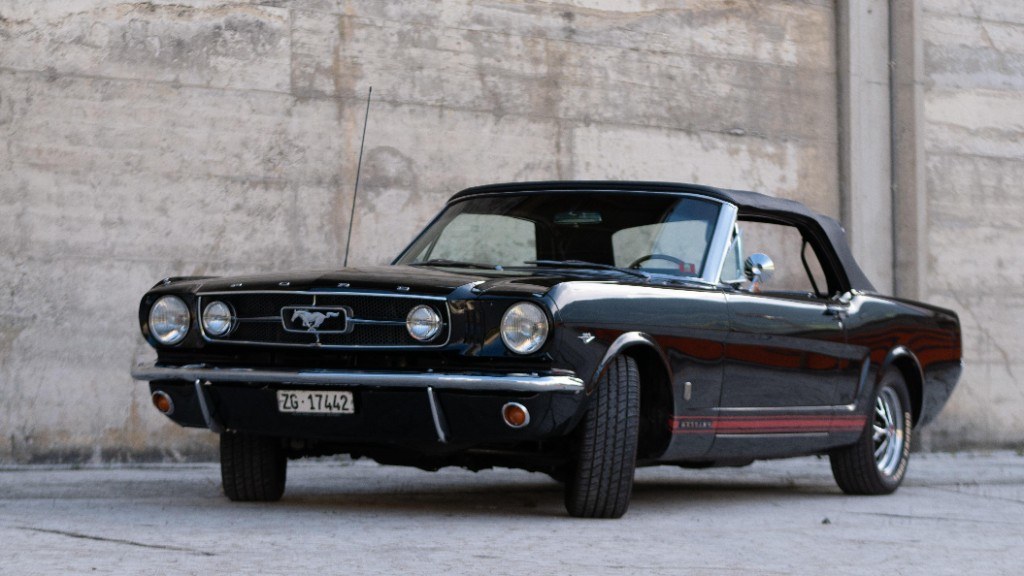
- Convertible 1965–1966: the same mechanicals, an open body with a factory-reinforced floor. In Switzerland, the emotional volume variant, with steady demand.
- Fastback 1965–1966: the “2+2” with a fastback roof, rarer than the Coupé and Convertible, and already clearly more expensive in this early form.
- Fastback / GT 1967–1968: the first facelift, a wider body, a big-block option (390) for the first time. The GT package brings front disc brakes, suspension and dual exhausts. The 1968 Fastback silhouette is the most iconic, and the most expensive, shape of the early Mustang.
- SportsRoof / Mach 1 1969–1970: the second facelift, squarer and more muscular; the fastback is now called SportsRoof. The Mach 1 combines a 351 V8 (and from the factory also the 390 and 428 Cobra Jet) with sports suspension and an equipment package. Big-block cars play far above the table on price.
- 1971–1973: the last, clearly larger and heavier body. On the market, the cheapest way to drive a first-generation Mustang. Sound cars sit noticeably under the ranges in the table; it is mainly the Mach 1 versions that are sought after.
The Shelby GT350/GT500 and the Boss 302/429 are a price league of their own (six figures and well beyond) and a collecting field of their own, with their own fake risks. They are deliberately not part of this table.
Body: substance beats shine
The Mustang has a unitary body with welded front chassis rails. Rust here quickly becomes structural. Because practically every panel is available as a reproduction, fresh paint says nothing about the quality of the work underneath:
- Shock towers: the load-bearing weak point. The towers carry the springs and the upper control arm, crack under load and rust from inside. Question added reinforcement plates and fresh weld seams critically: a proper repair is jig work.
- Cowl: the inner box under the air intakes in front of the windscreen clogs with leaves and rusts through. The water then lands in the footwells. The water test on inspection takes a minute; the proper repair means opening the cowl.
- Floor pans and torque boxes: wet carpets (often a consequence of the cowl problem) eat the floors from above, road salt from below. Overlapping repair panels and thick, fresh underseal are warning signs.
- Rear wheel arches and spring mounts: the arches rot between the inner and outer panels, and the leaf-spring mounts (front spring eyes, rear perches) rust structurally. The whole rear axle hangs there.
- Convertible-specific: the open car lives on its factory-reinforced floor. If the reinforcements are missing after a cheap restoration, or rusted through, the car twists. You see it in binding doors and gaps that move when you jack it diagonally.
- Front and rear: distorted front chassis rails and creased boot floors give old accidents away. Gaps were never perfect from the factory, but they should be symmetrical.
Mechanicals: robust, cheap, but check them honestly
- V8 engines (289/302/351): Ford small-blocks are long-lived, cheap to rebuild and available in every state of tune. The critical points are overheating damage (tight cooling reserves are built in; a larger radiator is a sensible addition), low oil pressure when hot at idle, and home-brew tuning. The 302 (from 1968) and the 351 (Windsor or Cleveland, from 1969) are unproblematic everyday engines.
- Carburettor: originally an Autolite (2100/4100) usually sits on the engine, often replaced by a Holley or Edelbrock. A cleanly set replacement carburettor is not a fault; a poorly matched double-pumper on a tired engine is. Experience the cold start, the warm-up and the transition yourself.
- Gearbox: the C4 three-speed automatic is almost indestructible and cheap to overhaul; burnt (brownish) oil and slip are the warning signs. The Toploader four-speed manual is regarded as one of the most robust gearboxes of its era and brings a premium on the market.
- Suspension: double wishbones at the front with coil springs on the towers, a live axle on leaf springs at the rear. Simple, and fully supplied with new parts. Sagging leaves, worn bushes and tired dampers are normal and cheap to fix, but they belong in the price negotiation.
- Brakes and steering: drums all round are standard; front disc brakes (an option from 1965, standard in the GT package) are a real plus in today’s traffic. Retrofit disc or power-steering kits are common and sensible. In Switzerland the conversion has to be entered on the papers. A lot of steering play is typical of the age and usually adjustable.
Originality: VIN, date codes and the tribute question
- VIN and date codes: the chassis number sits on the left inner wing edge (from 1968 also visible under the windscreen) and on the door tag. The block, cylinder heads and ancillaries carry casting dates (date codes), which have to lie before the car’s build date. Door-tag codes give away the body style, the colour and the plant.
- Replacement engine or Matching Numbers: Ford did not systematically tie the engine number to the VIN on the early Mustang. “Matching Numbers” here means a correctly dated block of the right type. Very many cars run replacement engines; honestly declared, that is not a fault, but it lowers the value against a documented original drivetrain.
- Replicas (tributes): GT stripes, Mach 1 bonnets and K-code badges are catalogue parts. A GT or Mach 1 replica on a base car is legitimate, but it has to be priced as one. On 1967 and later cars a Marti Report (an extract of the Ford production data) clarifies the factory equipment; earlier, only code analysis helps.
- Restomod versus original: modernised cars (five-speed gearbox, injection, discs all round, modern air conditioning) are dynamically better and have a market of their own. On value, though, documented original condition leads in the long run. A restomod put back will never be an original car again.
Specific to Switzerland
The basics on veteran status, the MFK and import are in the knowledge section. For the first-generation Mustang:
- Veterans: every first-generation Mustang has long since reached the 30-year threshold. Wildly modified cars fail.
- US reimports: most of the supply came from the United States at some point. Dry-state cars (California, Arizona, Texas) are often the best bases in substance. The customs proof and the US title have to be complete; freshly imported auction stock with no Swiss inspection history needs budget and patience for the first presentation.
- Mile odometer and lighting: the mile odometer may in principle stay in Switzerland, but the km/h conversion has to be readable (an added scale or a conversion). US-standard lighting (red rear indicators, sealed-beam headlamps) is treated with varying strictness at the MFK. Amber indicators at the rear and approved headlamp units save you the arguments.
- Cars that have been in Switzerland a long time: examples with an old Swiss registration, inspection reports and a local service history take the whole import risk off you, and they are as a rule worth the premium.
What to look for on inspection
The checklist for the first-generation Mustang combines the common inspection catalogue with the points specific to this series. For the early Mustang in particular:
- Do not decide to buy without a lift or a pit: shock towers, floor pans, torque boxes and spring mounts decide the value, not the paint.
- Do the water test at the cowl: a cup of water in the air intakes in front of the screen shows in a minute whether the cowl box is tight.
- Start the engine cold and warm it up: oil pressure, coolant temperature and the behaviour of the carburettor and gearbox say more than any high-gloss engine bay.
- Match the VIN, the door tag and the date codes, and on GT, K-code or Mach 1 cars have the equipment proved (Marti Report, Ford documentation).
- On the Convertible, check the door gaps and the twist, and look at the floor reinforcements from underneath.
- On reimports, look at the customs proof, the US title and the MFK history, and price in missing conversions (lighting, odometer).
A Mustang that passes these points is among the most straightforward and cheapest V8 classics to run, with a parts supply that drivers of European classics can only dream of.