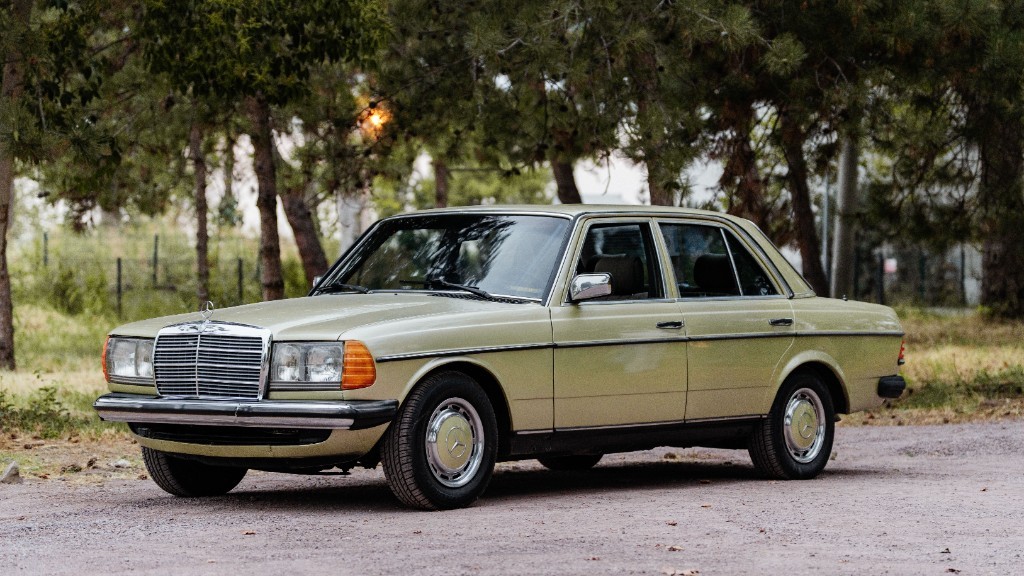
In brief
The W123 is the embodiment of the indestructible Mercedes: more than 2.7 million cars built, a taxi legend, diesels that cover a million kilometres. That very robustness is the biggest trap when you buy. The basic structure is so solid that the car still drives impeccably when the sills, the fuel system and the suspension are long past their best. A W123 that impresses you on the test drive can be a restoration case on the lift – the structure decides, not the first impression.
The short recommendation: the 230 E with the M102 injection engine (from 1980) is the best all-rounder – strong enough, economical, the best parts supply. If you want the classic W123 character, take a 240 D or a 300 D: near-indestructible, sought after, and in Switzerland often found with a well-kept first-owner history. The C123 Coupé is the collector variant, with the strongest rise in value. The engine variant matters less than the metal: better a rust-free 200 than a 280 E rotten through.
Variants and production years
- 200, 230, 250, 280 (1975–1980): the first generation, with carburettor four-cylinders (M115, Stromberg carburettor) and the six-cylinders 250 (M123, 129 hp) and 280 (M110). The fuel-injected 280 E (185 hp) is the top saloon.
- 200 D, 220 D, 240 D, 300 D (1975–1986): the diesels (OM615, OM616, OM617) made the W123 the taxi and long-distance legend. The five-cylinder 300 D (88 hp) is the most sought-after diesel; documented mileages beyond 500'000 km are not unusual.
- 200/230 E (1980–1986): the facelift with the more modern M102 four-cylinders, the 230 E (136 hp) as the best-selling petrol model.
- Coupé C123 (1977–1985): 230 C/230 CE and 280 C/280 CE, barely 100'000 cars, shorter wheelbase, frameless side windows and no B-pillar. Today the most sought-after and most expensive body.
- T-Modell S123 (1978–1986): the first factory Mercedes estate, with hydropneumatic self-levelling on the rear axle. Well-kept 280 TE and 300 TD (turbodiesel) cars have reached collector status and sit, in price, between the saloon and the Coupé.
Gearboxes: four-speed manual (later an optional five-speed), very often the four-speed automatic. The automatic suits the character of the car and is unproblematic if the servicing is intact.
Body: rust decides the purchase
The W123 rusts less dramatically than its predecessors, but after 40 to 50 years no example is without a story. What you cannot see is what matters:
- Jacking points and sills: the classic W123 trouble spot. The inner sill is the direct continuation of the floor panel – visible rust at the sill tip almost always means extra work on the floor. Tap, mirror from inside, and be suspicious of fresh underseal.
- Rear wheel arches and front wing edges: favourite filler zones of cheap cosmetic jobs. A magnet or a paint-thickness gauge belongs at the viewing.
- Battery tray and rear valance: leaking battery acid eats the tray; the rear valance rusts from inside, out of the boot.
- Sunroof frame, C-pillars and drains: blocked drains at the windscreen, sunroof and doors are rust source number one. Bubbles under the C-pillar trim almost always mean rust-through from inside.
- Wheel-arch liners: dirt and moisture collect behind them for decades – if you can, look behind the liners instead of only at the paint.
Mechanicals: diesel, petrol, suspension
- Diesel engines OM615/616/617: near-indestructible with honest servicing, but not immortal. Tired prechambers and loss of compression show up on a cold start (long preheating, heavy knocking, blue smoke). Oil leaks at the engine and the injection pump are common. Important: the diesel must stop as soon as you pull the key – running on reveals leaks in the vacuum system.
- Petrol engines M102/M110/M115/M123: the M102 (200/230 E) is the most modern and the most straightforward engine in the series. The twin-cam six-cylinder M110 (280/280 E) runs silkily, but it needs more servicing and drinks more. On the injected cars the fuel-pump relay, the lines and the tank age out of sight – a sudden total failure does not announce itself.
- Carburettor (Stromberg) on the 200/230: it works perfectly when it is looked after; a worn or bodged carburettor causes starting problems and uneven running, and only runs cleanly again after an expensive overhaul.
- Cooling system on the petrol engines: the W123 rarely overheats spectacularly – it suffers quietly. A faulty thermoswitch loads the radiator, water pump and cylinder head for months. Ask about the coolant history.
- Front axle and steering: ball joints, tie-rod ends and the recirculating-ball steering wear with high mileages. More than two fingers of steering-wheel play in the straight-ahead position is not “charm of age”, it is a four-figure repair.
- Automatic: it shifts softly but noticeably – that is normal. A hard engagement, slip or delayed shifts at operating temperature are faults.
Equipment and originality
- Interior: MB-Tex vinyl is almost indestructible and, in good condition, neutral for value; cloth and leather age faster. Sagging seat springs, cracked Zebrano wood and above all a cracked dashboard are expensive items – crack-free original dashboards are traded as collector parts.
- Data card and matching numbers: compare the engine and chassis numbers and the colour and equipment codes with the Mercedes data card. Original colour combinations and an unbroken history fetch the top prices.
- Taxi past: many W123s had an earlier life as a taxi – often resprayed, with the mileage turned back. The giveaways are traces of Hellelfenbein (light ivory) paint under the door seals, filled holes in the roof (taxi sign) and a wear pattern that does not match the mileage.
Switzerland-specific
The basics on veteran status, MFK and import are in Knowledge. For the W123:
- Veterans: every W123 passed the 30-year mark long ago.
- Swiss first deliveries: the W123 sold extremely well in Switzerland, so many Swiss-delivered cars with an unbroken service book are still on the market. They are the first choice – often better equipped than German base models, and without a taxi history.
- High-mileage diesels: the diesels are in demand as everyday veterans. High mileage is not a reason to reject an OM617 if the service history is right – an honest 300 D with 350'000 km and records is worth more than a “freshly restored” one without papers.
What to watch for at the viewing
The checklist for the W123 combines the shared inspection catalogue with the points specific to this series. For the W123 in particular:
- Do not decide to buy without a lift or a pit – sills, jacking points and floor panels are half the car.
- Start the engine cold: on the diesel, judge preheating time and knocking; on the petrol engine, starting and warm-up.
- On the diesel, switch the engine off and check that it stops at once – running on means a vacuum leak.
- Bring a magnet or a paint-thickness gauge against filled wheel arches and wing edges.
- At least 30 minutes of test drive at operating temperature: automatic shift behaviour, steering play and suspension noises only show up warm.
- Compare the data card, service book and history with the condition of the car – and look specifically for taxi traces.
A W123 that passes these points is one of the most reliable and everyday-usable ways into the classic world – a car that, well looked after, will comfortably last the coming decades.