In brief
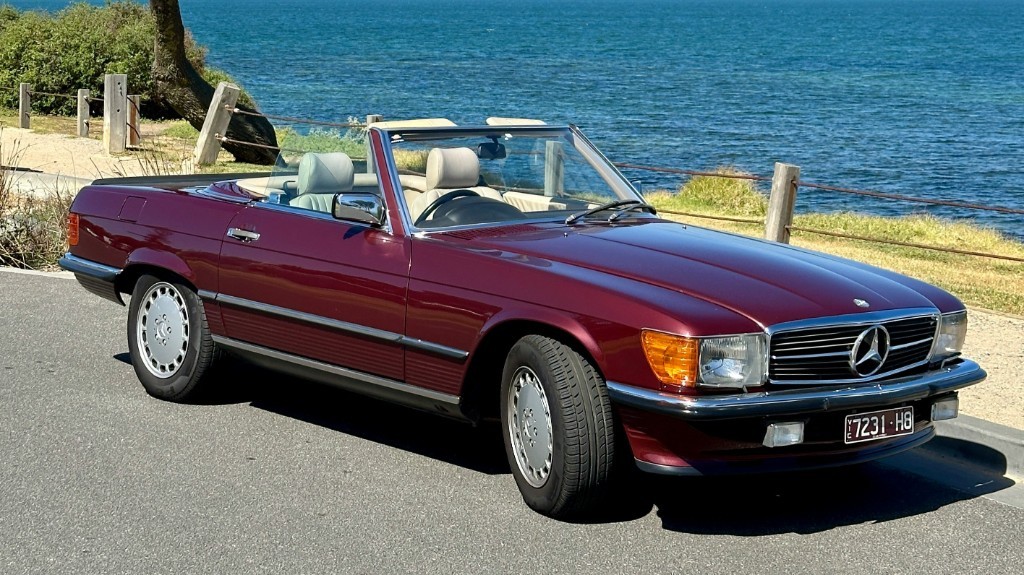
With 18 years of production (1971–1989), the R107 is the longest-built Mercedes passenger car of its era – 237'287 roadsters left the line, more than half of them for the USA. Technically derived from the S-Class, it is robust, usable every day and, with the hardtop, even in winter. The buying decision is still not made at the engine, but in the metal: the R107 prefers to rust from the inside out – at the scuttle under the windscreen, at the crossmembers, sills and jacking points. A car that looks dazzling can be structurally gone.
The short recommendation: the 500 SL of the last years (from 1986, with improved corrosion protection) is the most effortless and most value-stable choice. If you want to spend less, the 280 SL is the eager six-cylinder way in, with reasonable running costs. US reimports – above all the 560 SL, built only for export – are often structurally sound (dry states), but you need a budget for the European-spec conversion. The engine variant matters less than the structure: better the best 280 SL than a mediocre 500 SL.
Variants and production years
- 350 SL (1971–1980): the starting model, with the 3.5-litre V8 (M116, 200 hp). Early cars have D-Jetronic, and the chrome-trimmed simplicity of the first series.
- 450 SL (1971/73–1980): 4.5-litre V8 (M117, 225 hp), in the USA the volume variant from the start. An effortless long-distance car.
- 280 SL (1974–1985): 2.8-litre twin-cam six-cylinder (M110, 185 hp). Eager to rev, more economical, and in Europe the best-selling way into the series.
- 380 SL / 420 SL (1980–1985 / 1985–1989): the smaller facelift V8s (M116). Solid, but less sought after on the market than the 500 and the 560.
- 500 SL (1980–1989): 5.0-litre V8 (M117, 240–245 hp), the European top model. From the 1985/86 facelift, with better rust protection – the most sought-after years.
- 560 SL (1986–1989): 5.6-litre V8 (M117, about 230 hp with a catalytic converter), built only for the USA, Japan and Australia. As a reimport it shapes the Swiss supply; you recognise it by the federal bumpers and Sealed-Beam headlamps.
- 300 SL (1985–1989): 3.0-litre six-cylinder (M103, 188 hp), the more modern successor to the 280 SL in the facelift years.
Every variant was available with the four-speed automatic (almost standard on the V8s); manuals are more common on the six-cylinders and fetch a small premium with collectors. In 1989 the R107 handed over to the R129.
Body: rust from the inside out
The R107 is massively built, but its cavities hold moisture. Cosmetics can be managed; structural rust cannot:
- Scuttle and front crossmember: the most notorious zone. Rust at the windscreen frame and on the crossmember extensions under the headlamp bowls works from the inside out – once bubbles are visible, the damage is large. The repair means removing the screen and quickly runs to five figures.
- Sills and jacking points: they rust hidden, from the inside. Original jacking tubes carry a visible weld seam – if it is missing, someone has welded. No serious judgement without a lift.
- Wing edges, wheel arches, inner wings: water traps behind the front wings and around the headlamp mounts; at the rear the folded edges rot. Chrome arch trims fitted later over the arches often hide holes.
- Subframe and axle mounts: check the area above the subframe bushes and the rear spring seats – here rust becomes structural and expensive.
- Soft-top well and rear: blocked soft-top-well drains flood the floor panels and the rear crossmember. Check the boot floor and the rear tips behind the bumpers.
- Filler check: bring a paint-thickness gauge or a magnet – many R107s were cheaply tarted up in the 1990s. From model year 1986 the factory corrosion protection is clearly better.
Mechanicals: V8 ancillaries, K-Jetronic, automatic
- M117 V8 (450/500/560): very long-lived at heart. The weak points are the chain tensioner and guides (take a rattle on a cold start seriously – a snapped chain means an engine rebuild) and oil leaks at the timing cover and rocker covers. A service history with oil-change records weighs more than the mileage.
- M110 six-cylinder (280 SL): an eager twin-cam engine, but it needs regular, time-consuming valve-clearance adjustment. Look for the records in the papers.
- Injection: early V8s have electronic D-Jetronic, from the mid-1970s K-Jetronic, late models KE-Jetronic. All of these systems run excellently when they are tight and correctly set; starting problems and a hunting idle point to the fuel distributor or warm-up regulator – specialist work, with four-figure bills.
- Automatic gearbox: shifts that you can feel, but that stay soft, are normal by design. Hard bangs, delayed engagement from P or slip are faults. Oil leaks at the gearbox and differential are the most common inspection finding of the series – a leak is rarely dramatic, but it belongs in the price negotiation.
- Suspension and brakes: robust and well supplied. Worn steering joints and tired bushes show up as a vague feel; replacement is straightforward and comparatively cheap.
Equipment and originality
- Soft top and hardtop: the fabric soft top lasts 15 to 20 years, then it becomes brittle and leaks – replacement, fitted, costs 3'000–5'000 francs. The hardtop belongs with the car; check the fit and, when you buy, make sure it is included.
- Interior: MB-Tex vinyl is practically indestructible and, in original condition, not a fault. Leather and velour age more expensively; Zebrano wood strips crack, dashboards split in the sun. Complete, original interiors determine the value.
- Matching numbers and data card: compare the engine and chassis numbers with the Mercedes data card, and verify the colour and equipment codes. Original colour combinations with a documented history fetch the top prices.
Switzerland-specific
The basics on veteran status, MFK and import are in Knowledge. For the R107:
- Veterans: every R107 has reached the 30-year mark – including the last years of 1989.
- US reimports: a large part of the Swiss supply, the 560 SL above all. Dry-state cars are often structurally excellent, but they bring Sealed-Beam headlamps, federal bumpers, a catalytic converter, a mile odometer and the fragile automatic climate control. Clean customs and conversion documentation is mandatory; the European-spec conversion costs several thousand francs.
- Swiss deliveries: Swiss first deliveries with an unbroken history are rare and structurally more in demand than on offer – priced accordingly. European 500 SLs with a Swiss history are among the most sought-after R107s of all.
What to watch for at the viewing
The checklist for the R107 combines the shared inspection catalogue with the points specific to this series. For the R107 in particular:
- Do not decide to buy without a lift or a pit – scuttle, crossmember and sills rust from the inside out.
- Start the engine cold: chain rattle on the V8 and an uneven warm-up of the injection are expensive warning signs.
- Bring a paint-thickness gauge or a magnet against filler cosmetics, and question the chrome arch trims over the wheel arches.
- Open and close the soft top fully, check the soft-top-well drains and the floor panels for water traces, and test the hardtop fit.
- On US reimports, look at the customs papers and the conversion documentation, and build the conversion cost into the price.
- Test the automatic at operating temperature, and compare the data card, service book and records with the condition of the car.
An R107 that passes these points is one of the most straightforward classics there is – a long-distance roadster that, even after 50 years, still drives like a modern car.