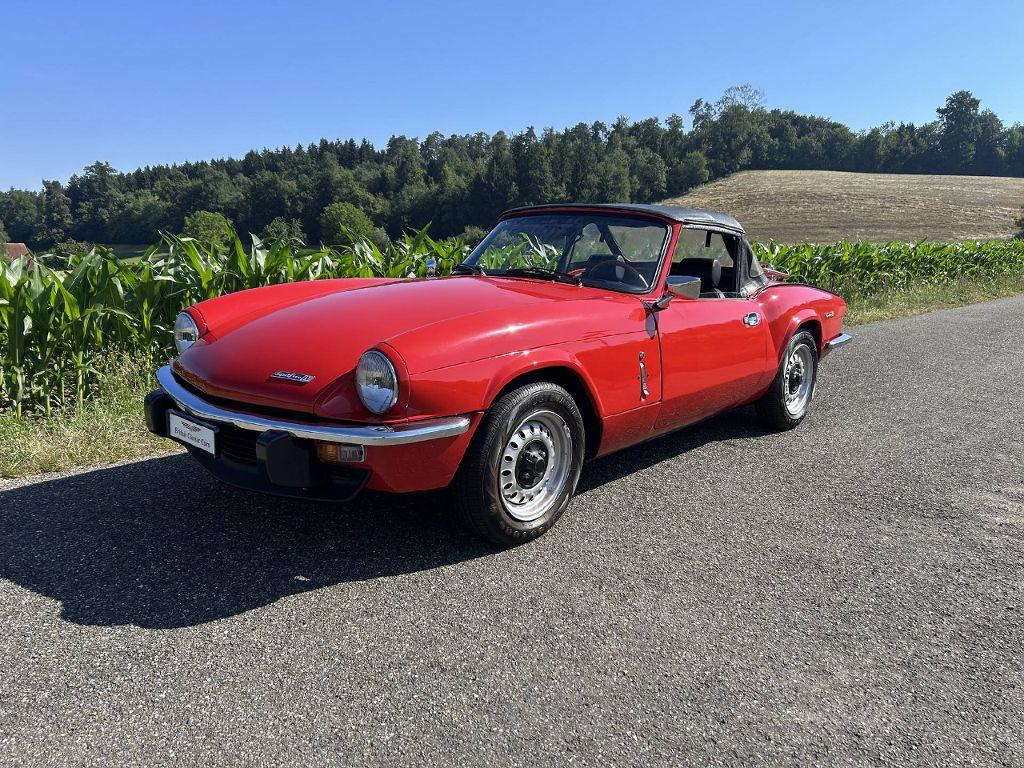
The essentials in brief
The Triumph Spitfire is the most approachable British roadster of its era. From 1962 to 1980 about 314'000 were built in five series, drawn by Giovanni Michelotti on Triumph Herald engineering. That means a backbone chassis with a bolt-on body, a front that tilts forward as one piece, and engineering you can service yourself with basic tools. The parts supply is excellent, the club scene is large, and running costs are low. The buying decision is not made at the engine, though, but at the chassis: rotted outriggers and eaten main rails turn the cheap way in into a restoration project, because a proper chassis repair means separating body and chassis.
In short: the Spitfire 1500 is the most practical choice. The strongest, the most comfortable, the most often offered, and the most forgiving thanks to the swing-spring rear axle. If you want the original Michelotti design, with the low chrome bumper, aim for the Mk I or Mk II, the collector cars of the series, with the price level that goes with them. The Mk III is the compromise of the early line and the strong 1296 engine, the Mk IV the cheapest way in. Substance matters more than the series. Better the best Mk IV than a 1500 with a patched chassis. If you want a fixed roof, look at the GT6, the six-cylinder fastback offshoot, which we treat here as a series of its own.
Variants: Mk I to 1500
- Spitfire 4 / Mk I (1962–1964): the original, a 1147 cm³ four (63 hp, two SU carburettors), sidescreens and a simple slot-in soft top. The pure, fine-boned Michelotti line. Today the most sought-after and rarest series.
- Spitfire Mk II (1965–1967): a gentle update: 67 hp, a new grille, carpet instead of rubber mats for the first time. Technically and visually close to the Mk I, about ten per cent below it on the market.
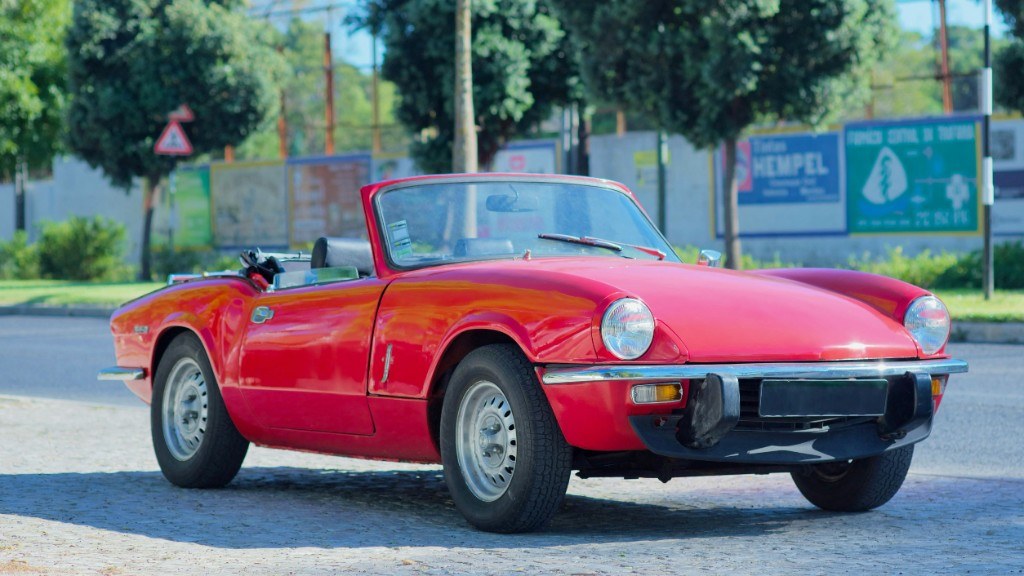
- Spitfire Mk III (1967–1970): the 1296 cm³ engine brings 75 hp, the strongest Spitfire of all. A proper folding soft top for the first time, and in exchange the raised front bumper («bone in the mouth»). In price, the sweet spot among the early cars.
- Spitfire Mk IV (1970–1974): a major rework: a smoothed body with a new tail, a synchronised gearbox, and above all the swing-spring rear axle, which takes the sting out of the swing axle's nasty tuck-under. The 1296 gives a detuned 63 hp here. That is why it is the cheapest series.
- Spitfire 1500 (1974–1980): the 1493 cm³ engine, with 71 hp and clearly more torque, makes the Spitfire usable on the motorway for the first time. A longer axle ratio, optional overdrive. US versions are detuned to about 53–57 hp and, from 1979, wear black rubber bumpers. As re-imports they are cheaper, but less sought after.
Chassis and body: this is where the buying decision is made
The Spitfire carries its body on a backbone chassis with side arms, the outriggers. That is exactly where the risk sits:
- Outriggers and main rails: the outriggers carry the body mounts and rust from the inside. Blisters visible on the outside mean advanced decay. The main rails around the differential and the rear leaf spring, and the front chassis extensions, are critical too. Old welded patches over rust are common. A clean repair means separating body and chassis, and on a cheap car it blows the budget.
- Sills and floor panels: the bolt-on body takes its stiffness from the sills. Repair panels slipped over the top are the classic. Doors that stick, and gaps that wander with the soft top down, give away soft substance.
- Tilt front: the one-piece bonnet, which tips forward, rusts on the wheel-arch edges and around the headlamp pods. Distorted hinge brackets and uneven gaps point to accident damage. A good used front is expensive.
- Rear valance, boot floor, A-pillar foot: water collects behind the wheel arches and in the boot. On the soft top, watch for watertight seams. Wet carpets feed the floor panels.
- Filler check: many Spitfires were «restored» cheaply in the 1980s and 1990s. Take a magnet or a paint-thickness gauge and check every edge.
Engineering: thrust bearings, trunnions, swing axle
- Engines (1147/1296/1493 cm³): all the fours come from the Herald parts bin. They are simple and durable, with one notorious exception: the crankshaft thrust washers. If these thrust bearings wear unnoticed, they fall out, and the walking crankshaft destroys the block. The test takes you a minute: with the engine running, press the clutch and watch the pulley for end float. The Mk IV and the 1500 are the ones mainly affected.
- Trunnions: the front uprights turn in bronze bearings, which must be lubricated with gearbox oil (EP90), not grease. If that was done wrong for years, the thread seizes, the upright snaps, and the front wheel tears off. Ask for proof of maintenance and check for play on the raised wheel.
- Swing axle versus swing-spring: up to the Mk III the rear is a Herald swing axle, which tucks under on a quick change of load and lets the tail step out. Drivable, but with respect. From the Mk IV the swing-spring layout (a transverse leaf pivoted at its mount) takes much of that behaviour away. Strong negative camber at rest means the transverse leaf has sagged.
- Differential and drivetrain: whining differentials and worn universal joints are everyday Spitfire life. On the torquier 1500, the diff is the best-known weak point. On the test drive, deliberately provoke whine under load and on the overrun.
- Gearbox and overdrive: crunching synchro rings in second and third, and bearing noise at idle, are common, but rebuilds are affordable. The optional Laycock overdrive is one of the most valuable options. Test it in third and fourth.
- Carburettors and electrics: SU carburettors (Europe) or Zenith-Stromberg (US) are simple to set. Uneven running is usually a matter of adjustment or wear. Lucas electrics live on clean earth points. Look critically at untidy added wiring.
Equipment and originality
- Engine number and origin: many Spitfires run on swapped engines. Not a technical problem, but on the Mk I/II it clearly reduces the value. Compare the engine number with the papers. A Heritage Certificate from the British Motor Industry Heritage Trust records the delivery specification and the original colour.
- US re-imports: a substantial part of the supply. Recognisable by a single carburettor, low compression, a mile speedometer and, from 1979, black rubber bumpers. A solid base, but less powerful and valued lower on the market. Converting back to European specification is possible, but it costs.
- Soft top, sidescreens, hardtop: on the Mk I/II the complete slot-in soft-top frame set is part of the collector value. Missing frames are expensive to buy back. An original factory hardtop is a sought-after extra on every series.
- Sensible conversions: a retrofitted overdrive, electronic ignition or an oil cooler count as value-neutral to positive. The widespread 1296 and 1500 transplants in early cars, by contrast, push down the collector value.
Specific to Switzerland
The basics of veteran status, MFK and import are in Knowledge. For the Spitfire:
- Veterans: every Spitfire passed the 30-year line long ago. A cleanly documented car pays off twice here.
- Supply: in Switzerland the adverts are dominated by the Spitfire 1500 and late Mk IVs, mostly between 11'000 and 25'000 francs. Early Mk I/II cars are rare and often change hands privately or through club contacts. Good cars from long enthusiast ownership, with a file of receipts, are the safest choice.
- MFK: the inspector looks where you should be looking too: chassis, outriggers, trunnions, brake pipes. A fresh report does not replace your own check, but it is a useful sign against nasty surprises.
- Parts: practically every part is available new (Rimmer Bros, Canley Classics and others). Swiss and southern German British-car specialists cover servicing and restoration. Almost always, the labour on the chassis costs more than the parts.
What to look for at the viewing
The checklist for the Spitfire combines the shared inspection catalogue with the model-specific points of this series. For the Spitfire:
- No buying decision without a lift or a pit. Outriggers, main rails and sills decide the purchase, not the paint.
- Do the thrust-bearing test: let the engine run, press the clutch, watch the pulley for end float. A crankshaft that walks means an engine rebuild.
- Have the trunnion maintenance documented (gearbox oil, not grease) and check the raised front wheel for play.
- A test drive with changes of load: diff whine, universal-joint clunks, and how the rear axle behaves in quick bends, experienced on purpose.
- Open the tilt front, check the gaps and the hinge brackets, and put the soft top up and down fully. On the Mk I/II, check that the soft-top frame set is complete.
- Compare the engine number, the papers and, ideally, a Heritage Certificate. On US re-imports, price in the specification and the cost of converting back.
A Spitfire with a sound chassis is one of the cheapest and most rewarding ways into the classic world: light, honest, manageable with a toolbox, and open for every evening run.