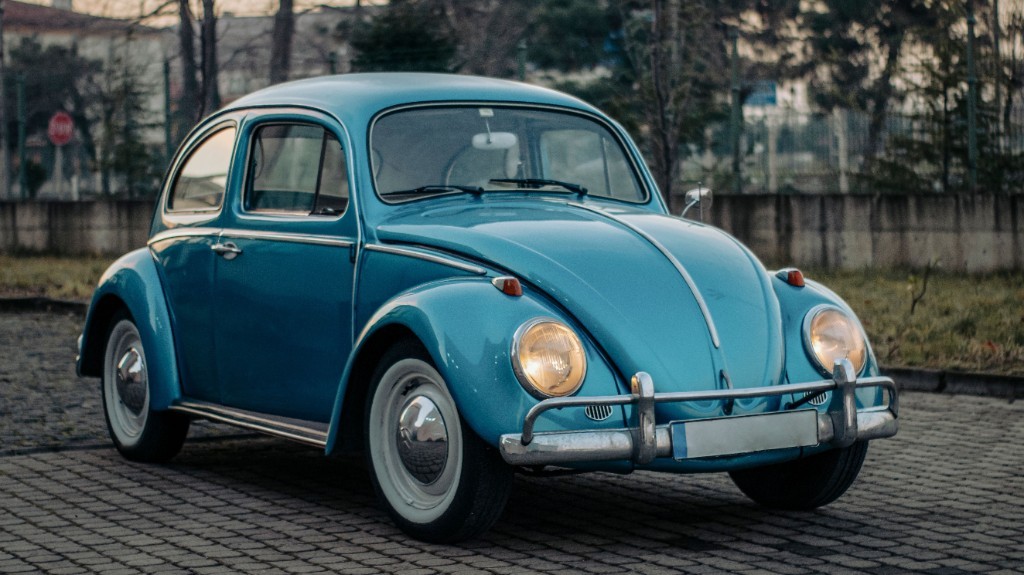
In brief
The Beetle is the best-selling car of its era and probably the most straightforward way into the classic-car world: parts supply almost complete, mechanicals simple, every bit of club knowledge freely available. That is also the trap. Hardly any classic has been cheaply “restored” so often. Shining paint over filled floor pans and a rusty frame head is the normal case on a Beetle, not the exception.
The short recommendation: a 1300 or 1500 from 1966–1973 is the best everyday compromise: 12-volt electrics (from 1967), decent performance, the classic line. Collectors go for the Ovali or an even earlier split-window, price-conscious beginners for the Mexico Beetle. The generation matters less than the substance: an honestly sound Mexico is the better buy than a tarted-up Ovali with a rotten floor.
Variants and production years
- Split (1946–1953): split oval rear window (“Brezel”), 25 hp. Pure collector territory, with prices sometimes clearly above the Ovali level.
- Ovali 1200 (1953–1957): one-piece oval rear window, 30 hp. The most sought-after “affordable” Beetle generation.
- 1200/1300/1500 (1957–1973): rectangular rear window (from 1957), 34–44 hp. The 1300 came in 1965, the 1500 in 1966 with front disc brakes (export), and from 1967 12-volt electrics. The backbone of the market.
- 1302/1302 S (1970–1972): MacPherson front axle, a larger boot, 1.3 or 1.6 litres. Long underrated, now catching up in price.
- 1303/1303 S (1972–1975): panoramic windscreen, a curved dashboard. The last German saloon evolution; after that the saloon ended in Germany.
- Mexico Beetle 1200 (1978–1985): Mexican production, officially imported to Europe. Technically the simplest and cheapest way in. Sheet-metal quality and rust protection are weaker than on late German cars, though.
The Karmann Cabriolet (1949–1980) is a market of its own and sits, depending on the generation, about 50–100% above the saloon values. The same check points apply, plus the soft top and the cabriolet-typical reinforcements at the sills and A-pillars.
Body: the frame head and the floor decide
The Beetle’s construction, a body bolted to a central-tube chassis, is easy to repair. That is exactly why it is full of scope for botched work:
- Frame head: the critical zone at the front of the central tube, where the front axle hangs. Water collects from inside, and the rust comes from there. Repair panels are available, but the work has to be clean. Driving safety is decided here.
- Floor pans: left and right of the central tube, under the batteries and the footwells. Replacement halves cost little; welding quality varies dramatically. Carpets out, look from above and from below.
- Body-to-floor sealing strip: if it rots, water stands in the cabin. Follow-on damage to the floor pans and seat runners.
- Spare-wheel well and headlamp bowls: classic rust spots at the front, often invisible from outside.
- Edges and channels: window channels, door bottoms, bonnet edges. Bubbles there mean: look over a wide area.
- Filler check: take a magnet or a paint-thickness gauge. Hardly any series has been filled thickly more often.
Mechanicals: simple, but not maintenance-free
- Boxer engine: air-cooled, robust, serviceable yourself with basic knowledge. Light oil seepage is built in; dripping pushrod tubes and oil seals are the usual jobs. A compression test is worth doing. A proper rebuild costs more than many Beetles are worth.
- Heat exchangers: they rust through and cost more than you expect; failed heat exchangers can feed exhaust gas into the cabin. Test the heater output on the test drive.
- Electrics: 6 volt up to 1966. It works if everything is cared for, but it does not forgive tired contacts. 12-volt cars (from 1967) are clearly better in everyday use.
- Suspension: the rear swing axle (up to the 1302/1303) needs a correct setting. Uneven tyre wear gives problems away. On 1302/1303 cars with a MacPherson front axle, check the strut mounts and struts.
- Gearbox: it lasts; weak synchromesh in second is the most common fault. Axle boots are wear parts.
Equipment and originality
- M-codes and the birth certificate: the AutoMuseum Volkswagen foundation issues a “birth certificate” (Geburtszertifikat) against the chassis number, with the original equipment. That clarifies colour, engine and specification.
- Originality beats accessories: a factory folding sunroof, export equipment and a documented history push the value. Lowering, a sports exhaust and US bumpers on European cars depress it.
- Mexico parts: many older Beetles carry Mexican replacement parts (lids, wings, engines). Not a fault in itself, but a price factor on cars offered as “original”.
Specific to Switzerland
The basics on veteran status, the MFK and import are in the knowledge section. For the Type 1:
- Veterans: every German Beetle, and the Mexico imports up to 1985, meets the 30-year threshold.
- AMAG history: from 1948 Switzerland was one of the first export markets. Swiss first deliveries with an AMAG history and unbroken papers are sought after and paid for accordingly.
- Clubs and parts: hardly any classic is better networked in Switzerland. Beetle clubs, specialists and parts dealers cover practically everything. That keeps running costs low, but it also makes cobbled-together cars harder to spot: records count for more than looks.
What to look for on inspection
The checklist for the Beetle combines the common inspection catalogue with the points specific to this series. For the Type 1 in particular:
- Do not decide to buy without a lift or a pit: the frame head and the floor pans are half the car.
- Lift the carpets and the rear seat: the view of the bare floor tells you more than any seller’s claim.
- Take a magnet or a paint-thickness gauge against filler restorations.
- Start the engine cold, and test the heater on the test drive (heat exchangers).
- Match the birth certificate or the M-codes against the car, and clarify the AMAG or import history.
- Check fantasy prices: the supply is large. For every overpriced Beetle, a more honest one is waiting at a fair price.
A Beetle that passes these points is one of the cheapest and most everyday ways into the classic-car world, with a parts and knowledge base that every other series can only dream of.