The essentials in brief
The MGB is the most-built British sports car of the twentieth century. From 1962 to 1980 more than half a million were made at Abingdon, about 387'000 Roadsters and 125'000 GT coupés. That is exactly what makes it the ideal way into classics: the engineering is simple and repairable in any village garage, and the parts supply is as good as on almost no other Oldtimer. Practically every panel and every wear part exists new, up to complete Heritage bodyshells. The buying decision is still not made at the engineering, but at the body. The MGB is unitary, and its sills are structure. A car with pretty paint and rotten castle sections is a restoration project, not a car.
In short: the chrome-bumper Roadster (up to 1974) is the original everyone wants. It costs the most and holds its value best. The GT, with the fastback roof Pininfarina had a hand in, is the quiet recommendation: the same engineering, more everyday use, a clearly lower price. Rubber-bumper cars (from autumn 1974) are the cheapest way in and just as solid mechanically. If the look and the higher ride height do not bother you, this is the most car for the money. Substance matters more than the variant, and so does overdrive: without it, motorway stages become a rev fest.
Variants and years
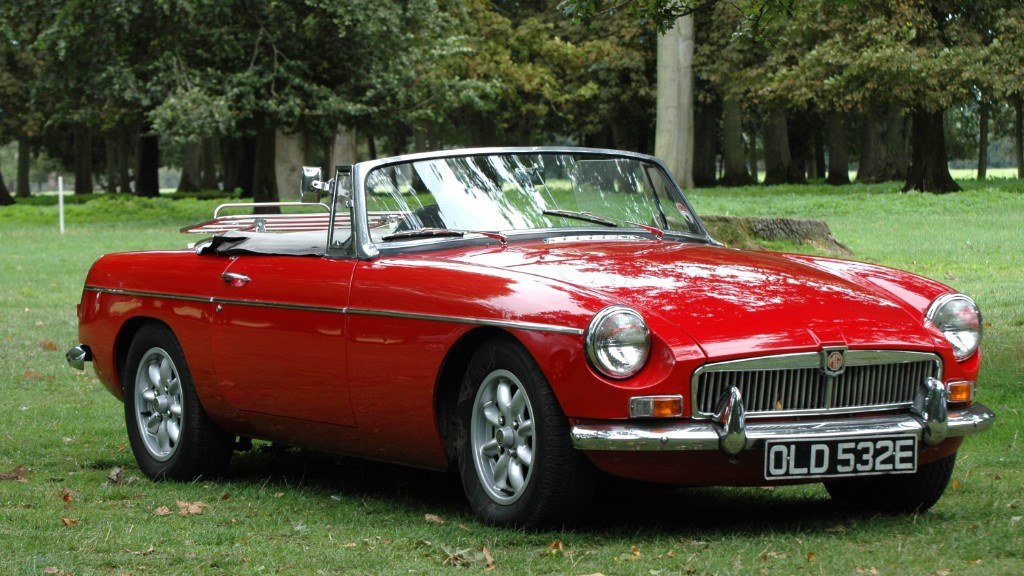
- MGB Roadster chrome bumper (1962–1974): the original, a 1.8-litre B-series (95 hp) and a chrome grille. Early cars (until autumn 1964), with a three-bearing crankshaft and pull-handle doors, are collector pieces. From 1964/65, five bearings. In 1967/68 the Mk II brought a fully synchronised gearbox.
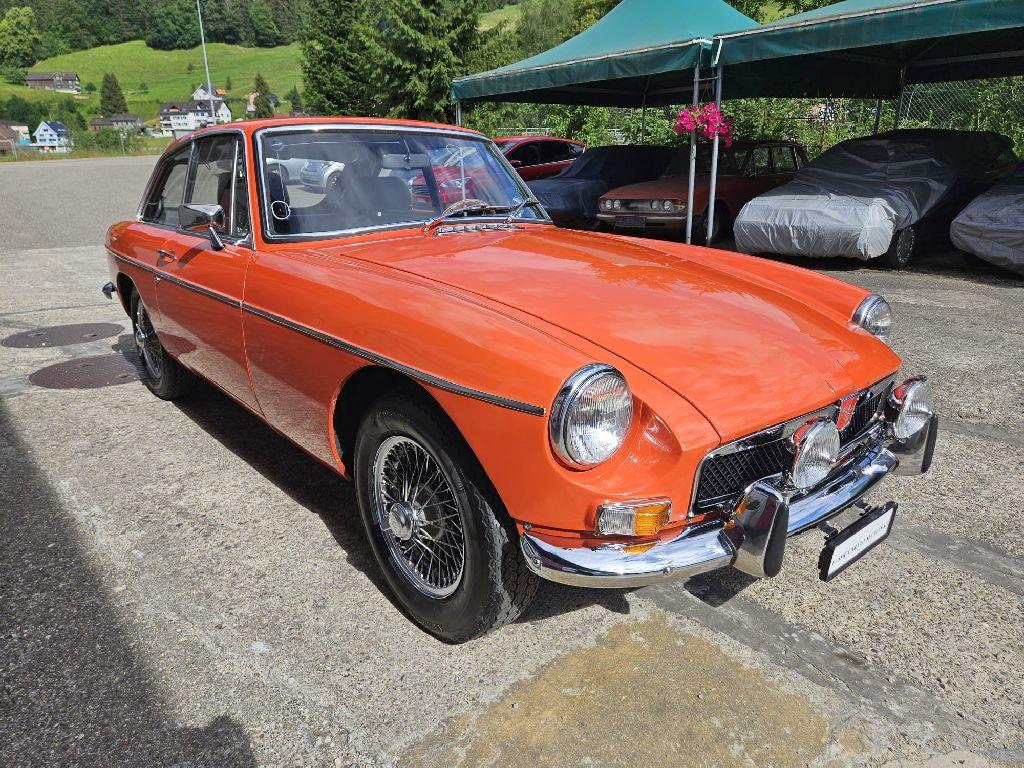
- MGB GT chrome bumper (1965–1974): the fastback coupé with a tailgate, the roofline drawn with Pininfarina. A 2+2 occasional seat, a stiffer body, quieter and usable in winter. Long undervalued, now sought after.
- MGB Roadster rubber bumper (1974–1980): from autumn 1974, black polyurethane bumpers and about 2.5 cm more ground clearance, both forced by the US rules. The handling is noticeably vaguer, improved again from 1976 with anti-roll bars.
- MGB GT rubber bumper (1974–1980): the coupé in its late form, often found in Switzerland as a cheap way in.
Outside these four core variants there was the MGB GT V8 (1973–1976, only about 2'600 cars, right-hand drive only) with the 3.5-litre Rover V8. A rare collector car in a price league of its own, hardly ever offered in Switzerland. At the end of production in 1980, MG built the Limited Edition (Roadster in bronze, GT in pewter metallic, together about 1'000 cars). A pleasant footnote, with a small collector premium, but mechanically an ordinary rubber-bumper MGB. Also common are conversions from rubber bumper to a chrome look (chrome grille, chrome bumpers, lowered suspension): better to drive, but for purists no substitute for a real chrome-bumper car. The conversion has to be done properly, documented and entered in Switzerland.
Body: the sills are the structure
In 1962 the MGB was one of the first sports-car monocoques. That means rust here is not cosmetics, it is structure. Thanks to British Motor Heritage, every repair panel and even complete bodyshells have existed new since 1988. What matters is not whether it was welded, but how well.
- Sills and castle sections: the three-layer sill (outer sill, membrane, inner sill with the crenellated castle sections) carries the open body. The classic sin is a new outer sill over a rotten core. Check from underneath, tap, and be suspicious of fresh underseal. On the Roadster a soft structure shows as sagging doors and gaps that change when the car is jacked.
- Floor pans and rails: carpets out, check from above and below. Water collects in the footwells. Leaking hoods and blocked drains speed the decay.
- Front wings: they rust around the headlamp bowls and along the rear edge towards the A-pillar, where dirt collects. New wings are available. The labour is what costs.
- Rear spring mounts and battery boxes: the front mounts of the leaf springs and the two battery boxes behind the seats rust out of sight. Both are load-bearing, and both can only be judged from underneath.
- Doors, arches, tail: door bottoms rot from the inside, rear arches bloom at the edges. On the GT, also check the tailgate frame, the gutters and the rear-window frame. Water marks in the boot are the warning.
- Heritage shells: cars built on a new Heritage shell are often excellent mechanically, but they do not count as original. That pushes the collector value down and has to be documented.
Mechanicals: simple, robust, everything available
- B-series engine (1798 cm³, about 95 hp): a tractor in the best sense. Long-stroke, torquey, practically unbreakable with regular oil changes. Oil pressure is the health indicator: warm, at speed, around 50 psi, at idle not under 10–15 psi. A full rebuild costs a few thousand francs, as little as on almost no other classic. Early three-bearing engines (until 1964) run more roughly and matter only to originality collectors.
- Carburettors: twin SU HS4 are standard and unproblematic when set up properly. Late US imports carry a single Zenith-Stromberg with reduced output. Putting the twins back is simple and usual.
- Gearbox and overdrive: until 1967 first gear is unsynchronised, after that the box is fully synchronised. The Laycock overdrive (third and fourth) is the most important extra. It drops the motorway revs clearly and brings a real premium at resale. Test it on the drive. Often only the oil level or the electrics are at fault, but an overhaul quickly runs to four figures.
- Cooling: tightly sized. Scaled radiators and tired water pumps show up in a summer queue. On the rubber-bumper car the closed front valance makes it worse. Added electric fans are common and sensible.
- Front axle with kingpins: the pins want grease every few thousand kilometres. Neglect that and they develop play. Check: raise the wheel, hold top and bottom, rock it. Replacements are available, but the work is involved.
- Rubber-bumper suspension: the body raised by about 2.5 cm from 1974 shifts the centre of gravity upwards in a way you feel. Early rubber-bumper cars (1975/76) also came without an anti-roll bar. Many cars are lowered today. Done properly that is a plus, bodged it is a fault.
Equipment and originality
- Hood (Roadster): a new hood, fitted, costs 1'500–3'000 francs. Check the fit, the clarity of the windows and the tensioning. An optional hardtop is a welcome extra.
- Interior: early cars have leather seat facings, later vinyl (leathercloth). From the 1970s, nylon striped cloth. Everything exists as a new part. A tired interior is negotiating room, an original one in good shape is a value argument.
- Matching numbers and Heritage Certificate: on the MGB this decides the price less than on a Porsche or a Mercedes, but a British Heritage Certificate (build date, delivery, original colour) documents the identity and costs little. Cross-check engine number and chassis number. On colour changes and conversions, ask for the history.
- Popular changes: wire wheels, an electric fan, electronic ignition, five-speed conversions. Reversible improvements hardly hurt the value. Cars that have been bodged without paperwork do.
Specific to Switzerland
The basics on veteran status, the MFK and import are in Knowledge. For the MGB:
- Veterans: every MGB passed the 30-year line long ago. Heavily altered cars (lowered, chrome conversion, engine tuning) need clean entries.
- UK imports and right-hand drive: Britain is the largest source of MGBs, with the widest choice and often attractive prices. Right-hand-drive cars can be registered in Switzerland without trouble, but they trade at a clear discount to left-hand drive. Conversions to left-hand drive are possible if they are done properly and documented. On UK cars, watch for earlier salt damage: a British winter is the MGB's natural enemy.
- US reimports: a large part of production went to the United States. Cars from dry states are often excellent in substance. Late US models bring a Zenith-Stromberg carburettor, reduced output and a mile speedometer. Putting the European specification back is simple and common. Read the customs and conversion papers.
- Swiss deliveries: Swiss first deliveries with a continuous history are rare and sought after accordingly. The Swiss market mostly sits between 13'000 and 27'000 francs. Above that, the freshly restored exceptions begin.
What to watch on a viewing
The checklist for the MGB combines the shared catalogue with the points of this series. For the MGB:
- No lift or pit, no buying decision. Sills, castle sections, floor pans and spring mounts are load-bearing and can only be judged from underneath.
- Fresh underseal and new outer sills without proof of the inner work are warnings, not selling points.
- Watch the oil-pressure gauge on the test drive and try the overdrive in both gears.
- On the Roadster, watch the door gaps while the car is jacked. On the GT, check the tailgate and the rear-window frame for rust and water.
- On rubber-bumper cars, establish whether the suspension and bumpers are original, lowered or converted to chrome, and whether it is all entered.
- Cross-check the history, the Heritage Certificate and, on imports, the customs and conversion papers against the car.
An MGB that passes these points is one of the most rewarding classics there is: cheap to run, repairable by any workshop, and with a parts supply every other Oldtimer owner envies.